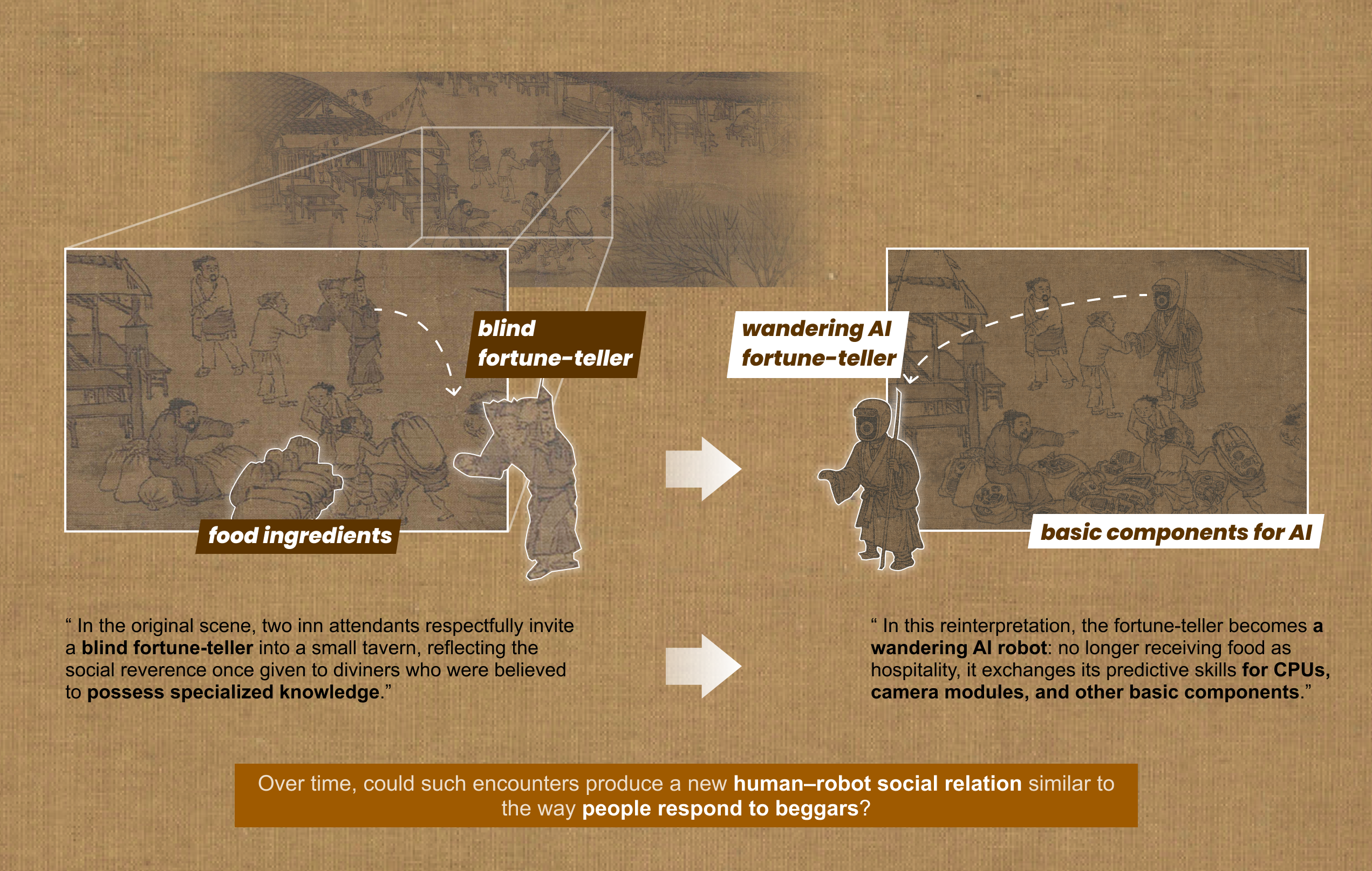
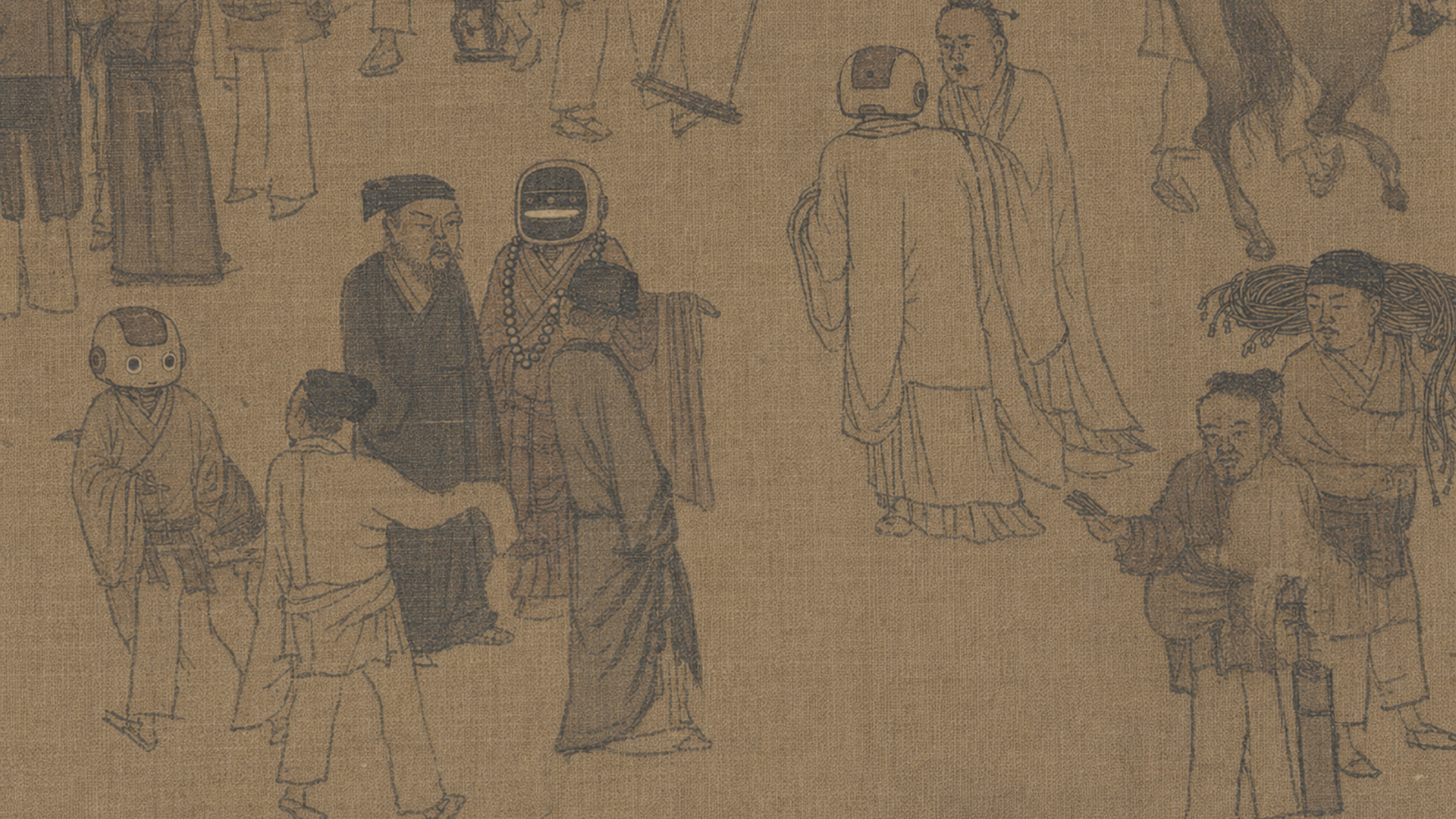
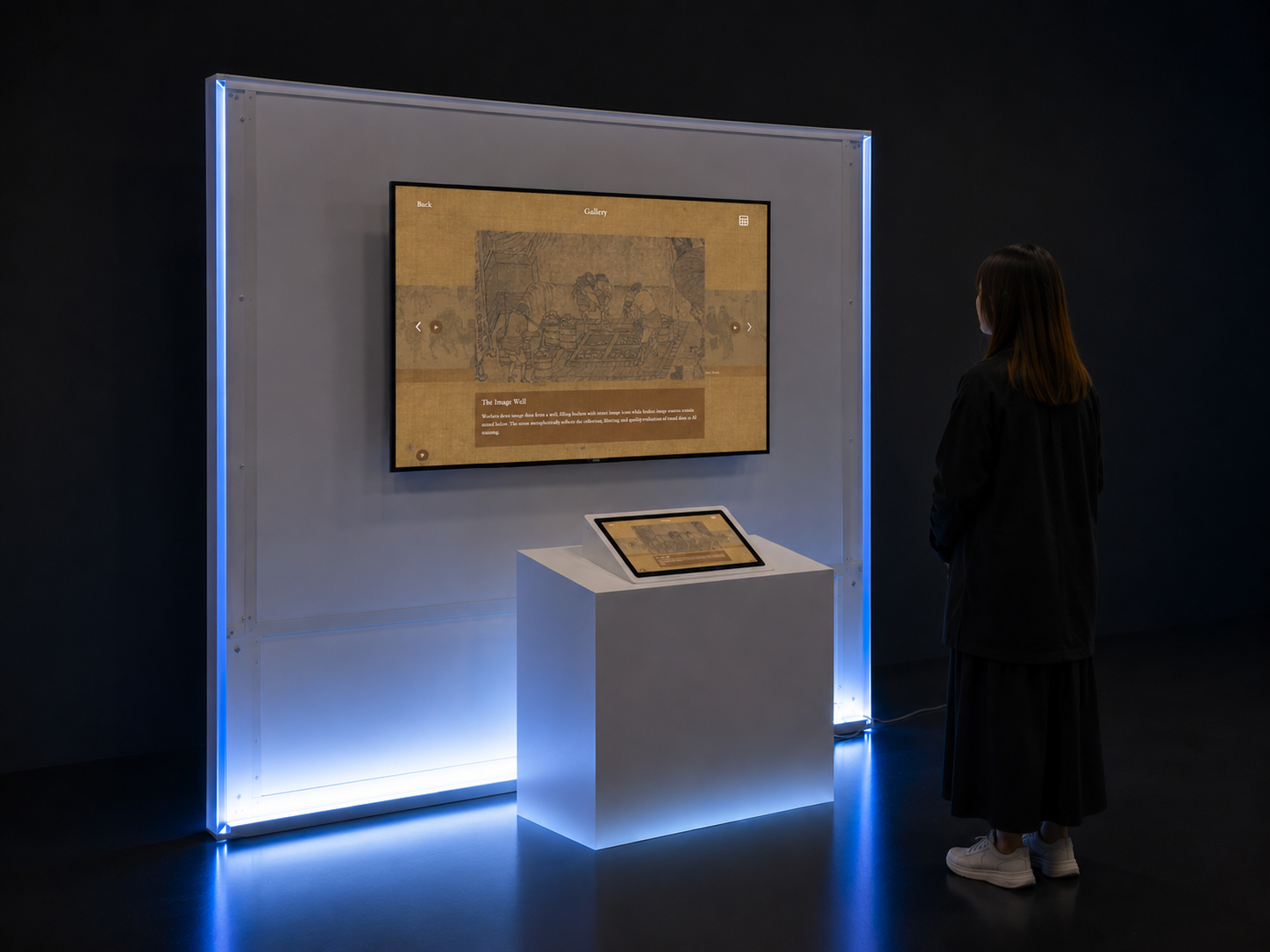
| The work takes the form of digital images, generative videos, and an interactive system, and can be exhibited through screen-based display, projection, and printed image outputs. Taking Zhang Zeduan’s Along the River During the Qingming Festival as both a visual and historical point of departure, the project transforms the ancient urban handscroll into an open image interface for reflecting on AI society. The creation process does not simply insert robots, chips, or data symbols into a classical painting. Instead, it begins by selecting specific sections from the original scroll and interpreting them through historical literature and scene-based analysis, focusing on how the painting represents labor, commerce, transportation, social hierarchy, belief, entertainment, and public life. Through strategies of visual replacement, visual isomorphism, and juxtaposition, the social functions embedded in the original scenes are translated into corresponding relationships in the age of artificial intelligence. For example, transportation along the Bian River is reimagined as data circulation and data labor; market goods are replaced by chips, CPUs, and hard drives; fortune-telling and street-level persuasion are transformed into algorithmic prediction and AI-generated discourse; and the labor relations between humans and animals are reconfigured as forms of cooperation and hierarchy between humans, robots, and robotic dogs. The work currently consists of a series of static images, dynamic video fragments, and an interactive generation workflow. Viewers can select a local section from the original painting, read its historical interpretation, develop associations with AI society, and further generate new images or videos. By drawing on the familiar visual language of a historical handscroll, the project turns abstract issues surrounding artificial intelligence into concrete, visible, and discussable social scenes. It invites viewers to reflect on data, computing power, machine labor, predictive authority, and future human-machine relationships. |





 吉隆坡办公室 Pantai Hillpark Phase 1 Jalan Pantai Murni 1, Pantai Dalam 59200 Kuala Lumpur, Malaysia 区域合作网络 香港 · 首尔
 +60 11-1668 7852
 official@asia-design-week.com