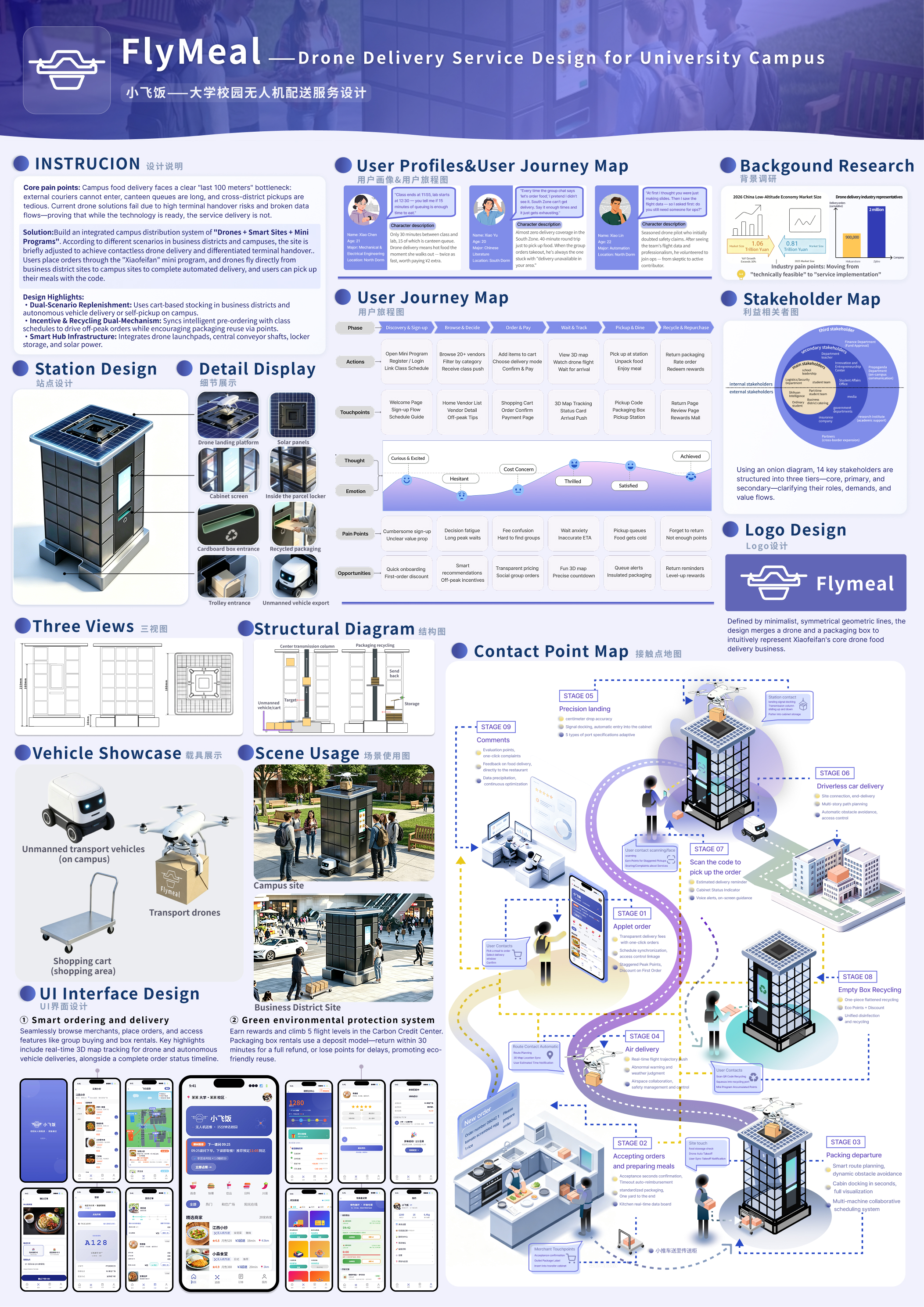
Xiaofei Food is a design solution for drone food delivery services in university campuses. The project re-designs the complete service system to solve the "last 100 meters" delivery problem in campus catering services.
Industry background: In 2026, the market size of China's low-altitude economy exceeded 1.06 trillion yuan, with a year-on-year growth rate of over 30%. Drone delivery has fully entered the commercial operation stage from technical verification. Meituan Drone has launched 65 routes and has received over 900,000 commercial orders; Zipline has delivered over 2 million orders globally, with a valuation of 7.6 billion US dollars. However, existing drone delivery projects mostly focus on community or medical scenarios, and the high-frequency campus market is still unexplored - and many projects still face the dilemma of "technically feasible but not delivered on the ground", urgently needing innovation in the service design level.
Scene selection: We focused on the university campus scenario. A typical campus with over 10,000 students and teachers has a daily high-frequency dining demand. The campus has unique pain points: out-of-campus merchants cannot enter the campus, there is long queuing at the cafeteria, and the cross-area walking distance is long. These constitute the "necessities" that drone delivery can efficiently solve.
User research: Through empathy maps, we identified three core user groups: students with tight class schedules, students living far from the cafeteria, and technology-savvy users. The core pain points include long queuing at the cafeteria peak, inability to enter the campus from outside, and long walking time for cross-area pickup.
Stakeholder analysis: We used an onion diagram to organize 14 stakeholders and identified the approval chain (school leaders → logistics department → security department → innovation and entrepreneurship center) as the key path for project implementation.
Physical site system: The core innovation is a multi-layer intelligent site system. The top of the site is a drone take-off and landing platform and a deformable opening. The food delivery is distributed to the designated cabinets through the central transmission column, up, down, left and right; the bottom of the platform integrates solar panels for power supply; the middle is a delivery cabinet with an interactive screen (below the screen is a packaging box recycling opening); the bottom side of the base has an opening for replenishment. This design eliminates the risk of human-machine collision and realizes fully automated end-to-end handover.
Dual-scenario differentiated operation: For different scenarios of commercial districts and campuses, we deploy compatible intelligent sites. Commercial district sites support push cart replenishment by merchants, while campus sites support unmanned vehicle delivery or user self-collection, adapting to different operating environments.
Digital products: "Xiaofei Food" mini-program connects order placement (menu browsing, intelligent reservation), real-time 3D map tracking, pickup, and evaluation throughout the chain. The 3D tracking page visualizes the movement trajectory of the drone and unmanned vehicle in the campus, providing users with a transparent delivery experience.
Operation mechanism: The points system is linked with the class schedule, intelligently guiding staggered order placement and timely pickup, serving as a behavioral guidance tool rather than a subsidy mechanism. The packaging box rental mechanism manages the lifecycle of the physical carrier, including deposit, buyout, and environmental incentives, achieving carrier recycling and reducing waste.
Business model: Student part-time light asset operation, low venue cost for campus, high-frequency necessity guarantee for order volume, sustainable operation. The model minimizes fixed costs and fully utilizes the existing infrastructure of the campus.
Service blueprint: A 5-stage × 5 lane service blueprint covers the complete journey of users. The 5 stages are: before order placement (menu browsing, order placement, reservation for delivery), out-of-cabinet handover (merchant receiving the order, delivering the food, loading into the site), flight transportation (the drone takes the food from the site, flies to the target site, and lands), landing pickup (the food is distributed to the cabinet, notifying the user, and the user picks up), completion (user evaluation, packaging box recycling, points settlement). The 5 lanes are: user behavior, front-end interaction (mini-program interface), back-end process (merchant operation, site operation), supporting process (drone scheduling, points system), physical evidence (site hardware, packaging box). The blueprint identifies and fixes all service break points.





 吉隆坡办公室 Pantai Hillpark Phase 1 Jalan Pantai Murni 1, Pantai Dalam 59200 Kuala Lumpur, Malaysia 区域合作网络 香港 · 首尔
 +60 11-1668 7852
 official@asia-design-week.com